The Latent Value in Transportation
Up to $150 billion data value Locked because of Energy
The transportation sector generates an estimated $30–150 billion in latent RWA data value across 1.4 billion vehicles globally. Not theoretical value — observable, monetizable data running every second.
Yet, nearly all of it is economically inaccessible. The physics of energy make it cost more to extract than it's worth to sell, silently trapping 90% of the potential value of vehicle RWA data.

Regulatory Shift
Regulation (EU) 2023/2854
Restructuring the Data Economy
"The data generated by a connected device belongs to the user who generates it."
Entering into force on January 11, 2024, and applying from September 12, 2025, the EU Data Act fundamentally rewrites the rules of engagement for vehicle and IoT data, establishing three core pillars:
-
1.
Forced Opening of the OEM Market:
The Data Act permanently ends manufacturers' data monopoly, legally obligating them to grant independent third-party access.
-
2.
Certified Enabling Infrastructure:
The law directly mandates independent hardware access to ensure data flow is not artificially constrained by closed systems.
-
3.
Unlocking RWA Tokenization:
Establishing that data belongs to whoever generates it is the absolute legal prerequisite for tokenizing data as a Real-World Asset and monetizing it through DePIN networks.
The Hardware Solution
The Hyper Low Power Revolution: Micro.sp® SOC
Lower Energy Magnitude
An order of magnitude improvement: a 10x reduction in energy per bit transmitted against Bluetooth LE's 200 nJ/bit.
15+ Years Autonomy
The same sensor on Micro.sp® lasts 15+ years on a single coin cell battery, compared to the 3-4 years of conventional tech.
TCO Slashed
10-year Total Cost of Ownership drops from $180 down to $45. Every $1 spent on Micro.sp® returns $3 to $6 in TCO savings.
$19+ Billion Savings
At fleet scale, this transforms the unit economics of data extraction from loss-making to highly profitable.
AI Integration
When Always-On Data Meets Always-Learning AI
Current sensor deployments are episodic, sending discrete snapshots that fundamentally constrain predictive models. Micro.sp® enables Always-On DC-AI — continuous, duty-cycle-managed data transmission for the vehicle's lifetime.
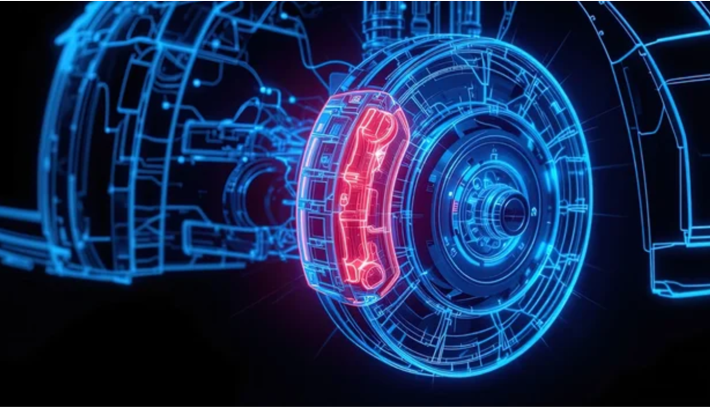
When you feed a continuous, high-frequency stream into a modern AI model, the diagnostic power becomes exponential. Algorithms can predict blowouts days in advance, detect brake micro-deformations, and model drivetrain wear patterns. This precision translates directly into eight-figure savings for large operators by simply eliminating the unknown.
The Architecture
From Sensor to Token: The Full DePIN Stack
With Micro.sp® as the extraction layer, the full value stack is finally complete:
- Layer 1 — Physical Extraction: Sensors embedded in consumables transmits continuous data at 22 nJ/bit, powered for 15+ years.
- Layer 2 — DePIN Aggregation: Data flows into decentralized physical infrastructure networks, where the owner receives token rewards.
- Layer 3 — AI Validation: The raw stream is cleaned and analyzed by AI to detect anomalies, generate predictive scores, and validate integrity.
- Layer 4 — Tokenization: Verified WRA data becomes a tradable Real World Asset on platforms, monetized by insurance and logistics operators.
Market Reality
The Numbers That Make This Real
STE Industries has already shipped 1.3 million Legacy Gen0 sensors into this market. The customer list includes Amazon, UPS, Bridgestone, Goodyear, Cummins, Aptiv, and Webfleet.
In the semiconductor sector, standard legacy architectures fundamentally cannot match Micro.sp® energy performance without violating their own energy budgets. The only way for incumbents to close this technological gap is to break backwards compatibility. However, doing so would force them to cannibalize their existing business and completely overhaul their commercial model, amounting to what is effectively economic suicide. Such a pivot would require a full architectural reset, the abandonment of consolidated toolkits, and the development of expertise they currently lack. This would trigger a multi-year decision-making process hindered by severe internal organizational resistance, ultimately granting us a strategic advantage and a highly defensible execution window.


The End Game
The Convergence Point
We are at an inflection point where three powerful forces are converging: Regulatory sovereignty (EU Data Act), AI computational maturity, and Hyper Low Power silicon.
Together, they shift the vehicle from a closed OEM data asset to an open, user-owned, AI-enriched, blockchain-verifiable node in a global decentralized infrastructure network. The only bottleneck was energy.
22 nanojoules per bit. That is the number that changes everything.